The Perseids are now within their strongest interval of 2026, and this return deserves unusually careful attention. The shower reaches its nodal maximum on August 13 while the Moon is new, so the limiting factor will not be lunar glare but the familiar combination of cloud, transparency, artificial light, and radiant altitude. This is about as clean a natural experiment as visual meteor observers receive: a strong annual stream presented against a genuinely dark sky.
The maximum is a window, not a minute
The International Meteor Organization's 2026 calendar places the principal nodal maximum between 02:00 and 04:00 UTC on August 13. Historical observations show that the broad or traditional maximum can fall anywhere from 21:00 UTC on August 12 to 09:00 UTC on August 13. That twelve-hour span is the more useful guide for planning because the Perseid profile is not a sharp switch. Rates rise, fluctuate, and decline as Earth crosses a structured meteoroid stream rather than a perfectly uniform sheet of dust.
There are two additional reasons not to reduce 2026 to a single advertised peak time. Dynamical calculations place Earth near one branch of a very old 1079 dust trail at 16:53 UTC on August 12, and a weak modeled filament lies near 01:00 UTC on August 13 with an uncertainty of roughly five hours. Neither prediction justifies claims of a meteor storm. Old trails disperse, model encounters can be geometrically close without being rich in visible particles, and a possible filament sits on top of the normal shower background. They do, however, make disciplined observations across several nights scientifically more valuable than a casual hour at the nominal maximum.
For western Europe, the 02:00–04:00 UTC core translates to 03:00–05:00 in the United Kingdom and 04:00–06:00 in Central European Summer Time. Twilight will intrude toward the end at many sites, but the radiant will be high. Across eastern North America, the same interval falls late on the evening of August 12, with the radiant already usable and improving; farther west it arrives too early, so the hours after local midnight remain the better visual compromise even as the formal maximum recedes. In East Asia the core occurs in daylight. Observers there should favor the pre-dawn sky on August 13 and, if conditions permit, repeat the watch before dawn on August 14. The broad profile and the history of occasional post-maximum structure make both sessions defensible.
What a rate of 100 actually means
The quoted zenithal hourly rate is 100. ZHR is a normalized population measure: it estimates what one observer might record if the radiant were at the zenith, the sky reached a stellar limiting magnitude near 6.5, and the field were unobstructed. It is not a promise of one meteor every 36 seconds from a suburban garden. Trees, haze, cloud, light pollution, time lost looking away, and a low radiant all reduce the count. Under a transparent rural sky, a patient observer may see several tens of Perseids per hour near the best part of the night; an urban observer can miss most of the faint population while still catching a few bright events.
The radiant is near right ascension 48 degrees and declination +58 degrees, in northern Perseus. Mid-northern latitudes therefore have the strongest geometry, with the radiant becoming reasonably elevated by about 22:00–23:00 local time and climbing through the morning. Much of the Southern Hemisphere sees it low or not at all, and far-northern sites can lose darkness to summer twilight. Do not stare at Perseus. Meteors close to the radiant look short because they approach nearly along the line of sight; the longest, most dramatic paths often appear 40 to 90 degrees away. A reclining position with a broad view about halfway up the sky is more productive than a telescope or binoculars.
Perseid meteoroids enter at about 59 kilometers per second. That speed produces swift streaks, persistent trains, and occasional fireballs when larger fragments arrive. The stream comes from comet 109P/Swift–Tuttle, whose roughly 133-year orbit repeatedly replenishes the complex of trails that Earth samples each August. A visible meteor is normally made by a particle far smaller than its display suggests; excitation and ionization along a long atmospheric path create the luminous phenomenon, not a large object burning close to the observer.
Use the moonless night well
New Moon occurs on August 12, coinciding with the total solar eclipse earlier that day. For Perseid observers the consequence is simple: there is no lunar penalty anywhere on the planet. Site quality becomes decisive. Choose the darkest safe location that remains reachable under the final cloud forecast, favor dry transparent air over a nominally darker site in haze, and avoid placing a town or highway in the sector of sky you intend to watch. Give your eyes at least 20 to 30 minutes without white light. Red light should be dim, not merely red.
StargazingPal is most useful here as a decision layer rather than a substitute for watching. Compare several saved sites with the hourly Stargazing Index, cloud forecast, satellite imagery, Bortle map, Moon phase, and the event calendar. A one-hour drive toward a genuine clearing can matter more than small differences in the modeled peak time. Check again before departure: convective cloud and smoke can change a promising August forecast rapidly.
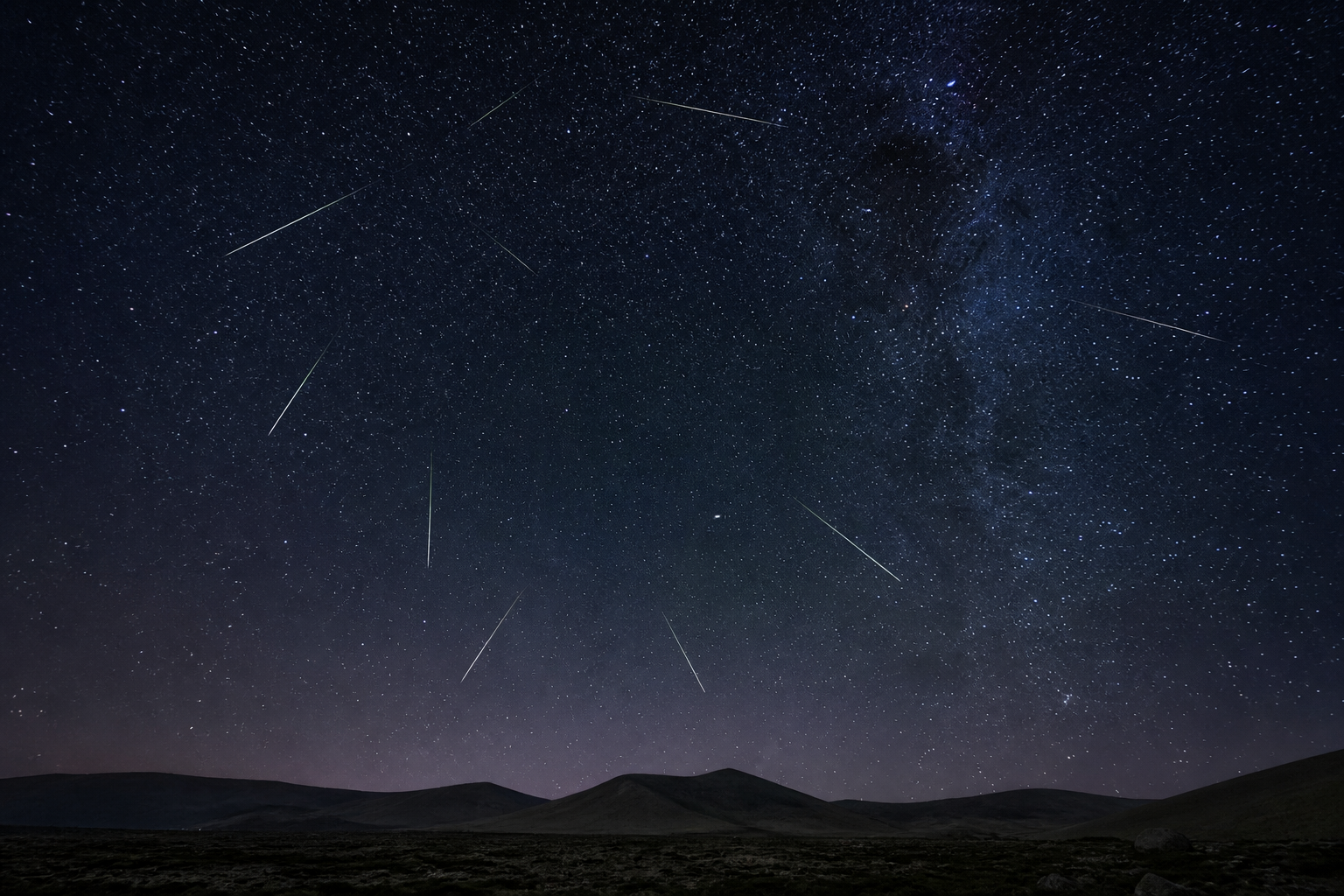
For photography, begin with a wide, fast lens on a fixed tripod, manual focus confirmed on a bright star, and an exposure short enough to keep the stars acceptably round. Depending on focal length and sky brightness, that often means roughly 10–20 seconds at f/1.4–f/2.8 and ISO 1600–6400, followed by uninterrupted interval shooting. Compose before darkness and keep spare batteries warm and accessible. If several meteor frames are combined later, disclose the composite and preserve the true path and direction of every streak; moving meteors to improve the composition turns a record into an illustration.
A useful observation is more than a total
Observers who want their session to retain scientific value should record start and end times in UTC, effective observing time, sky limiting magnitude, cloud obstruction, radiant altitude or site coordinates, and counts in intervals no longer than 30 minutes. Note meteor magnitudes and persistent trains separately. Those details are especially relevant in 2026 because a weak trail or filament could alter the brightness distribution without producing a spectacular increase in the total rate.
The best plan is therefore pleasantly simple: watch for more than one hour, cover more than one night if weather allows, and resist the urge to judge the shower after ten quiet minutes. Under a moonless August sky, the 2026 Perseids do not need exaggeration. Their value lies in the combination of strong annual activity, fast bright meteors, and an unusually clean background against which even the fainter members of the stream can be seen.