June is not only meteor season and Milky Way season. For observers in the middle and high northern latitudes, it is also the opening of one of the most atmospheric skywatching windows of the year: noctilucent clouds. They are not clouds in the ordinary weather-forecast sense. They are the visible edge of ice clouds near the mesopause, far above the troposphere where our familiar weather lives, and they appear only when the geometry of twilight is just right.
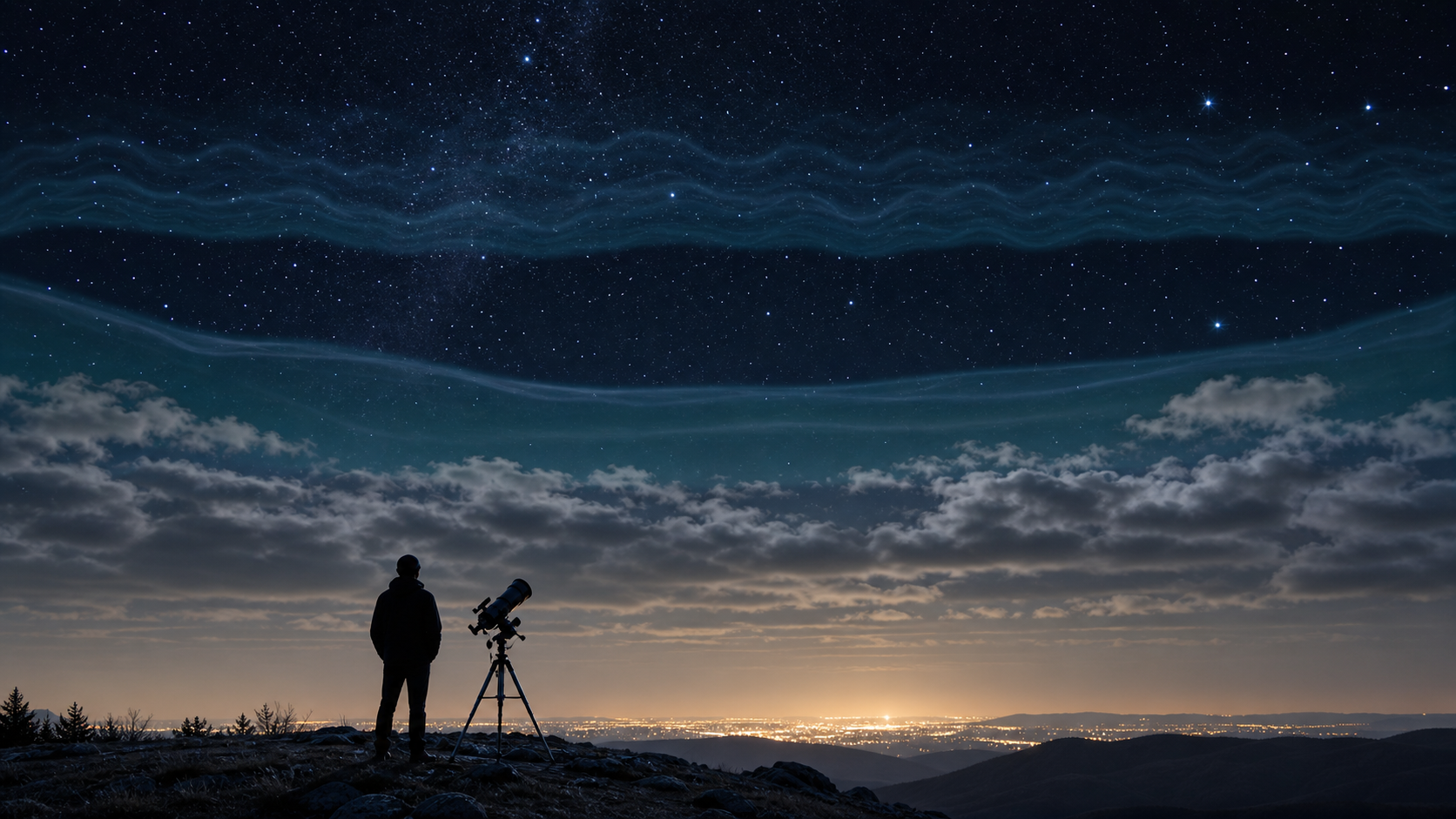
The essential geometry is simple and beautiful. After sunset, or before sunrise, the ground and the lower atmosphere have already entered shadow. Very high clouds near the mesosphere can still catch sunlight from the Sun below the horizon, so they glow blue-white against a darker sky. NASA's Space Cloud Watch describes this as a summer, high-latitude phenomenon seen just before dawn or just after sunset. The World Meteorological Organization places the usual ground-observing zone roughly in the middle to high latitudes, about 50 to 65 degrees north or south, with sightings rarer below about 45 degrees and difficult at the highest polar latitudes because the summer sky remains too bright.
What To Look For
A genuine noctilucent cloud display has a different texture from ordinary twilight cirrus. It often looks electric, silvery, or blue-white, with fine bands, ripples, billows, or whirls. It is usually seen toward the twilight sector of the sky: toward the north in the northern hemisphere during the late evening and around the opposite twilight direction before dawn. The display may sit low, perhaps 15 to 20 degrees above the horizon, but strong events can climb much higher.
Ordinary tropospheric clouds behave differently. They are far lower, usually warmer in color near twilight, and they darken quickly once direct sunlight is gone. Noctilucent clouds can remain luminous after first-magnitude stars begin to appear. That contrast is one of the best field tests. If the cloud seems to shine while darker foreground cloud is already in shadow, you may be looking at the mesosphere.
Why They Matter Scientifically
Noctilucent clouds are made of tiny ice crystals at altitudes often described in the range of roughly 50 miles, or 80 kilometers, above Earth's surface. At those heights, water vapor is scarce and the air is extremely thin. Ice formation requires cold temperatures, available water, and tiny particles that can act as condensation nuclei. Meteoritic dust is one plausible source of such particles, which is a pleasing connection between the upper atmosphere and the same solar system debris streams that produce meteors.
Their changing range and frequency are scientifically interesting. NASA's Space Cloud Watch is built around the idea that citizen observations, including reports of absence, can help researchers track how noctilucent cloud visibility changes over time. NOAA has also emphasized that polar mesospheric clouds are among the highest clouds in Earth's atmosphere and are most often seen in summer twilight because they reflect sunlight from such great altitude. A single photograph will not solve upper-atmosphere climate physics, of course, but a large number of carefully timed, geolocated observations can become useful.
The 2026 Observing Window
For the northern hemisphere, the WMO describes the usual observing season as mid-May through mid-August, with occurrence tending to peak just before and for several weeks after the summer solstice. That makes early June a good time to begin checking the twilight sky, especially from Canada, the northern United States, the United Kingdom, Ireland, Scandinavia, northern Europe, and comparable latitudes across Asia. The farther south you are, the more exceptional a sighting becomes; the farther north you are, the more twilight brightness competes with the display.
Start 30 to 90 minutes after sunset and check again before dawn if your schedule allows. An open poleward horizon is important. A hill, coast, lake shore, field edge, or rooftop with a clear view can make the difference between seeing a low display and missing it entirely. Light pollution is less destructive here than it is for galaxies or the Milky Way; the harder constraints are twilight geometry, foreground cloud, haze, and horizon access.