The Milky Way is not a single target that appears the same every clear night. It is a seasonal, horizon-dependent, moon-sensitive structure whose best presentation depends on geography, darkness, transparency, and timing. A successful Milky Way night is planned in layers, and each layer removes a common failure point before you ever leave home.
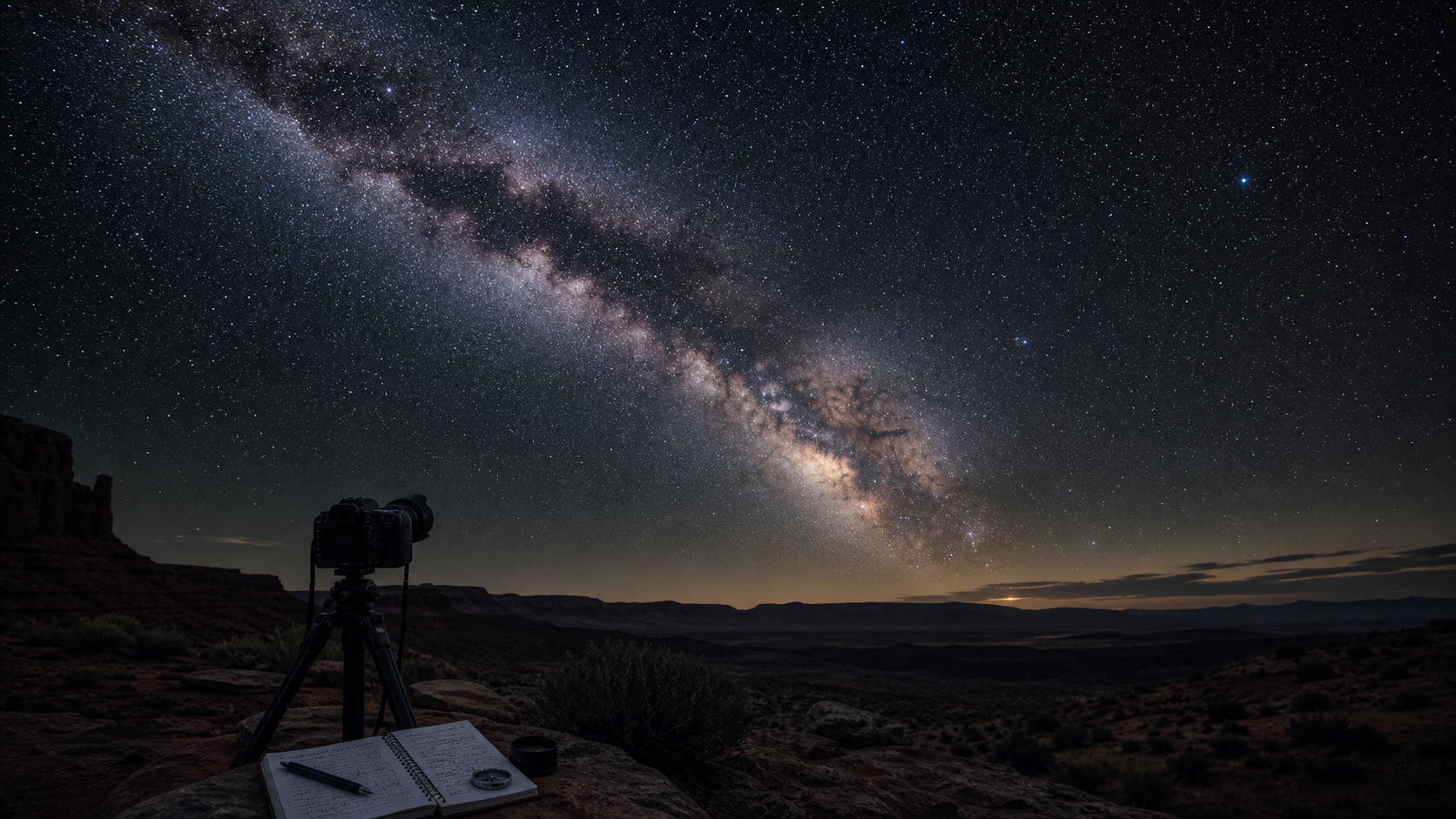
Start With The Right Milky Way Season
For northern mid-latitudes, the brightest central region of the Milky Way is generally best placed from late spring through early autumn. Early in the season it rises in the pre-dawn hours. By midyear it becomes an evening and midnight target. Later in the season it shifts toward the early evening and sets sooner. Southern Hemisphere observers often enjoy a higher, longer view of the galactic center because it climbs farther above the horizon.
Season alone is not enough. You also need to know when the core is above your local horizon, when astronomical darkness occurs, and whether the Moon is present during that overlap. A night can be technically in Milky Way season and still fail if the core rises after twilight but just before moonrise, or if terrain blocks the southern sky.
Layer 1: Moonlight
Moonlight is the strongest natural source of sky brightness for Milky Way observing. A full or bright gibbous Moon can wash out the galactic core even from a dark site. New Moon is ideal, but the best practical windows are defined by moonrise and moonset, not phase alone. A crescent Moon that sets before the core climbs high can be harmless. A half Moon above the horizon during the main window can be a serious problem.
Use a time-based approach. Identify the hours when the Milky Way core is well placed, then check whether the Moon is below the horizon during those hours. If the Moon is above the horizon, evaluate its illumination, altitude, and angular distance from the Milky Way. Low, thin crescent moonlight may be acceptable for casual viewing. For photography of dust lanes and faint structure, darker is better.
Layer 2: Bortle Class And Local Light Domes
The Bortle Scale gives a practical language for sky darkness, but it should be used with map context. A Bortle class 3 site facing a large city glow in the south may be worse for the galactic center than a similar site with the light dome behind you. Direction matters because the Milky Way core is often low enough that horizon glow can erase the most interesting structure.
When choosing a site, evaluate both the class and the direction of nearby towns. Look for a dark southern horizon in the Northern Hemisphere, or the relevant horizon direction for your composition and latitude. If two locations have similar darkness, choose the one with a cleaner horizon, safer access, and less local lighting from roads, campgrounds, buildings, or passing cars.
Layer 3: Horizon And Composition
The galactic core rewards planning because it interacts strongly with the landscape. A mountain ridge, desert arch, lake reflection, observatory dome, or lone tree can turn a record shot into a composed image. For visual observers, horizon openness is just as important. The lower Milky Way can disappear behind terrain long before it becomes obvious in the sky.
Scout in daylight when possible. Confirm parking, walking distance, ground safety, foreground alignment, and whether any artificial lights point into the observing area. If you are imaging, mark tripod positions and rough camera directions before dark. If you are observing visually, choose a place where you can sit or lie back without blocking your own view.
Layer 4: Transparency And Weather Risk
The Milky Way depends heavily on transparency. Humidity, thin cloud, dust, and smoke can reduce contrast even when stars remain visible. High clouds are especially frustrating because they may not look severe in a basic forecast, yet they scatter nearby light domes and flatten the sky. A transparent Bortle class 4 night can outperform a hazy Bortle class 2 night for visible structure.
Check cloud timing hour by hour. You want the clearest sky during the Milky Way's best altitude, not merely at sunset. Also check wind, temperature, and dew risk. Dew can end a camera session by fogging a lens, and wind can ruin long exposures even under perfect stars. For visual observing, comfort matters because the Milky Way often rewards patient dark adaptation rather than quick glances.
Layer 5: Camera And Visual Preparation
For photography, bring a wide lens, sturdy tripod, remote release or intervalometer, spare batteries, and a headlamp with a dim red mode. Start with a wide aperture, high ISO, and an exposure short enough to keep stars from trailing too much for your focal length. Then refine based on the histogram and star sharpness. Manual focus should be set carefully on a bright star and checked after temperature changes.
For visual observers, the key equipment is simpler: a reclining chair or blanket, warm layers, a red light, and time. Dark adaptation can take 20 to 30 minutes, and phone screens can reset it quickly. Avoid staring only at the brightest part of the Milky Way. Sweep along the band and use averted vision to bring out larger structure and dark lanes.
A StargazingPal Planning Checklist
In StargazingPal, begin with the annual event and Milky Way planning context, then move into location-specific checks. Compare candidate sites on the Bortle map. Use Moon phase, moonrise, and moonset to isolate dark windows. Check the stargazing index and hourly weather for the same window. Review cloud maps close to departure time, then save a backup location in case the clearing line shifts.
- Two weeks out: choose candidate dates around the darkest lunar window and identify two or three sites.
- Three days out: begin comparing cloud trends, transparency indicators, and smoke or haze risk.
- Same day: confirm hourly cloud timing, road access, temperature, wind, and dew risk.
- On site: preserve night vision, let your eyes adapt, and keep checking whether the best sky window is arriving earlier or later than expected.
What A Strong Plan Looks Like
A high-confidence Milky Way plan has a clear dark window, a target above the horizon, low Moon interference, acceptable Bortle class, a clean view in the right direction, and stable weather for several continuous hours. A weak plan usually depends on one lucky assumption: that clouds will clear exactly on time, that a low horizon is unobstructed, or that a bright Moon will not matter.
The goal is not to remove all uncertainty. The sky will always keep some of its own authority. The goal is to know which variables matter most and to make every controllable part of the night work in your favor.