A clear forecast is only the beginning of a good observing plan. Many disappointing nights happen because the sky is technically cloud-free but still poor for the target: haze reduces galaxy contrast, upper-level turbulence turns planets into boiling disks, or a thin cloud sheet slowly erases the Milky Way. Professional observers separate these effects because each one damages a different part of the experience.
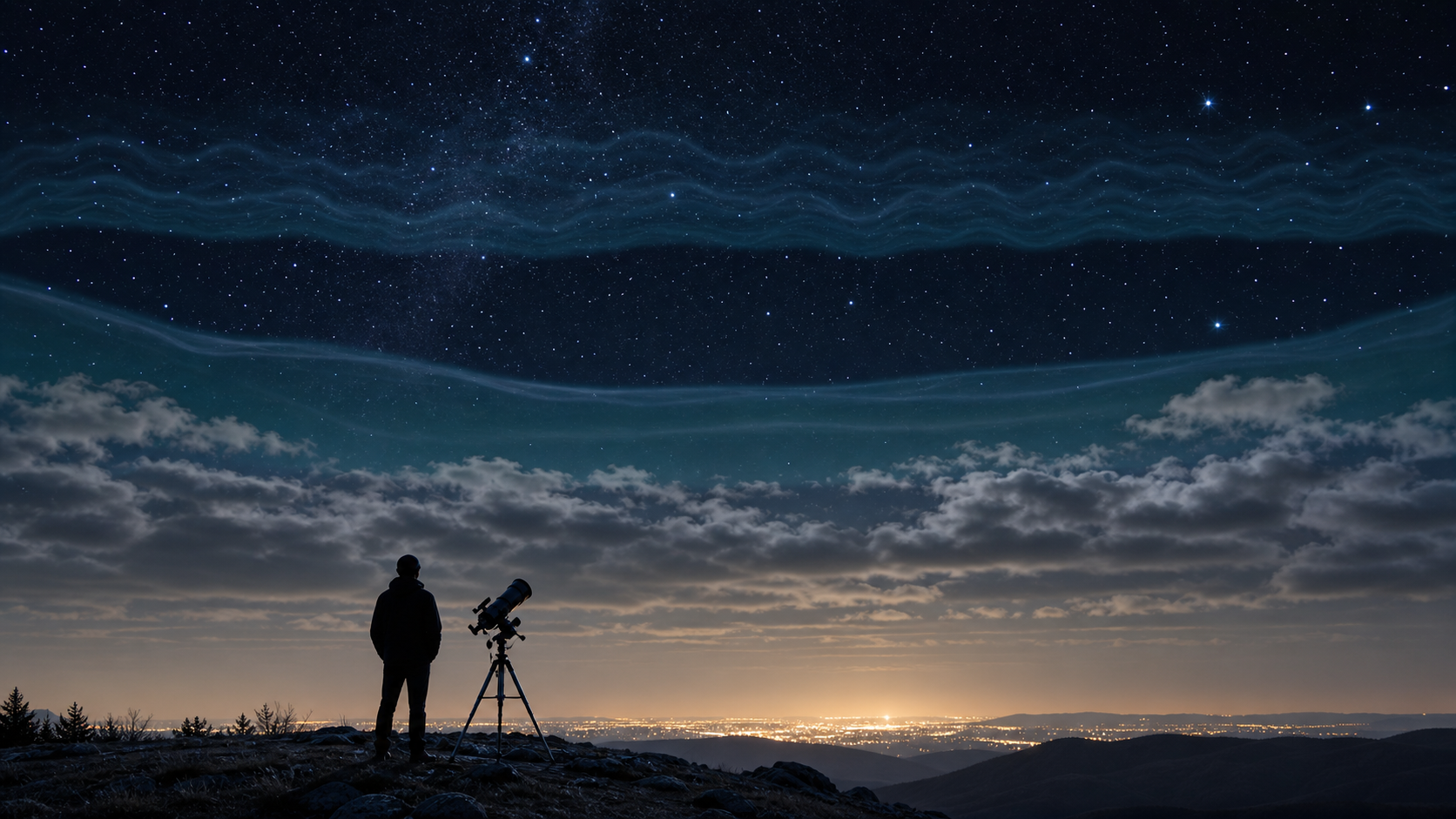
Clear Sky Is Not One Variable
For practical planning, sky quality can be broken into three primary layers: cloud cover, transparency, and seeing. Cloud cover describes how much of the sky is blocked by clouds. Transparency describes how cleanly light passes through the atmosphere. Seeing describes how stable the atmosphere is at high magnification. These conditions can agree, but they often diverge.
A night with broken low clouds is usually poor for all targets because the sky is physically blocked. A cloudless but humid night can still be weak for nebulae and galaxies because water vapor and aerosols scatter light and brighten the background. A dry, transparent night can be excellent for the Milky Way but mediocre for Saturn if fast upper-level winds make the image shimmer in a telescope.
Cloud Cover: The First Pass Filter
Cloud cover is the most obvious constraint, but it should be read by layer and timing rather than as a single percentage. Low clouds can move quickly and may leave windows between cells. Mid-level clouds often create patchy extinction that makes star charts unreliable. High cirrus can look harmless at twilight but later smear bright stars, halos around the Moon, and faint contrast across the entire sky.
When evaluating a forecast, look for trends over the full session. A location that is 20 percent cloudy at 9 p.m. and 80 percent cloudy after midnight may be useful for a quick planet session but unsuitable for meteor showers, deep-sky imaging, or Milky Way work. Conversely, a cloudy sunset does not always cancel the night if satellite loops show a clearing line arriving before your target reaches its best altitude.
Transparency: The Deep-Sky Multiplier
Transparency is the measure of how much faint light survives the path through the atmosphere. It is affected by humidity, haze, dust, smoke, aerosols, sea mist, and low-level pollution. Deep-sky objects are most sensitive to transparency because galaxies, nebulae, and the Milky Way depend on subtle contrast between faint structure and the sky background.
Poor transparency has recognizable signs. The horizon glows more than expected. Bright stars look soft even when they are not twinkling strongly. The Milky Way appears thinner or loses structure near the horizon. Long-exposure photos show a brighter, flatter background with less separation between dust lanes and star clouds. In a telescope, faint galaxies can become invisible even under a nominally dark Bortle class.
The practical rule is simple: if your target is extended and low contrast, transparency matters more than almost anything except moonlight and light pollution. A slightly darker site with poor haze can lose to a less remote site with clean, dry air.
Seeing: The High-Magnification Constraint
Seeing is the steadiness of the atmosphere. It controls whether fine detail remains coherent at high magnification. Planetary observers, lunar observers, double-star observers, and anyone using long focal lengths care deeply about seeing. It is possible to have excellent transparency and poor seeing on the same night.
Signs of poor seeing include rapidly twinkling stars, a planet that refuses to focus sharply, and lunar detail that ripples like it is underwater. Local conditions matter too. A telescope set up over pavement, a rooftop, a parked car, or a heat-radiating wall can suffer from local thermal turbulence even when regional seeing is acceptable.
For planets, patience often helps. Atmospheric steadiness can vary from minute to minute. If Saturn looks soft, do not immediately increase magnification. Wait for calmer moments, keep the planet centered, and use only as much power as the sky supports. A smaller, sharper image is usually better than a larger blurred one.
Target-Based Decision Making
The best forecast depends on what you plan to observe. A professional workflow begins with the target type, then weights the forecast variables accordingly.
- Planets and the Moon: prioritize seeing, target altitude, and telescope thermal stability. Moderate light pollution and some moonlight are usually acceptable.
- Galaxies and nebulae: prioritize transparency, low humidity, dark sky, and low Moon illumination. Thin cirrus or haze can ruin contrast.
- Milky Way viewing: prioritize Bortle class, Moon timing, southern horizon clarity, and transparency across the lower sky.
- Meteor showers: prioritize wide-area clear sky, low Moon interference, comfort, and a site with an open field of view.
- Astrophotography: combine all variables, then add wind, dew risk, battery temperature, and the target's altitude curve.
A Practical StargazingPal Workflow
Use StargazingPal as a layered decision system rather than a single yes-or-no signal. Start with the stargazing index to identify promising nights. Then inspect hourly cloud cover and cloud maps to confirm whether the clear window overlaps your target. Add Moon phase, moonrise, and moonset to judge natural sky brightness. Finally, compare nearby locations with the Bortle Scale map and saved favorites.
For a high-value session, create a simple go/no-go threshold. For example: no Moon above the horizon during the main deep-sky window, cloud cover below roughly 25 percent for at least three continuous hours, no obvious satellite cloud band approaching, and a target altitude above 30 degrees. The exact numbers can change by observer and target, but writing the threshold before the evening prevents wishful thinking from taking over.
When To Stay Local And When To Travel
Travel is most valuable when the limiting factor is light pollution or horizon access. It is less valuable when regional clouds, smoke, or humidity cover the whole area. Before driving to a dark site, compare the forecast at home, the destination, and at least one backup site along a different weather corridor. If all three share the same cloud deck, the trip is unlikely to pay off. If a clearing boundary is sharp, a short relocation may matter more than a long drive to a theoretically darker place.
Good observing is not luck alone. It is the result of matching target, atmosphere, location, and timing. Once you learn to read cloud cover, transparency, and seeing separately, the forecast becomes less mysterious and your best nights become much easier to recognize.