On August 12, the Moon's umbral shadow will cross northern Russia, Greenland, Iceland, the North Atlantic, Spain, and a very small part of Portugal. For most people in the path, totality will last less than two minutes. To a solar physicist that brief darkness is not an interruption of daylight but a rare observing configuration: the photosphere is removed by a natural occulting disk, exposing the inner corona at spatial scales that are difficult to reach cleanly with an artificial coronagraph.
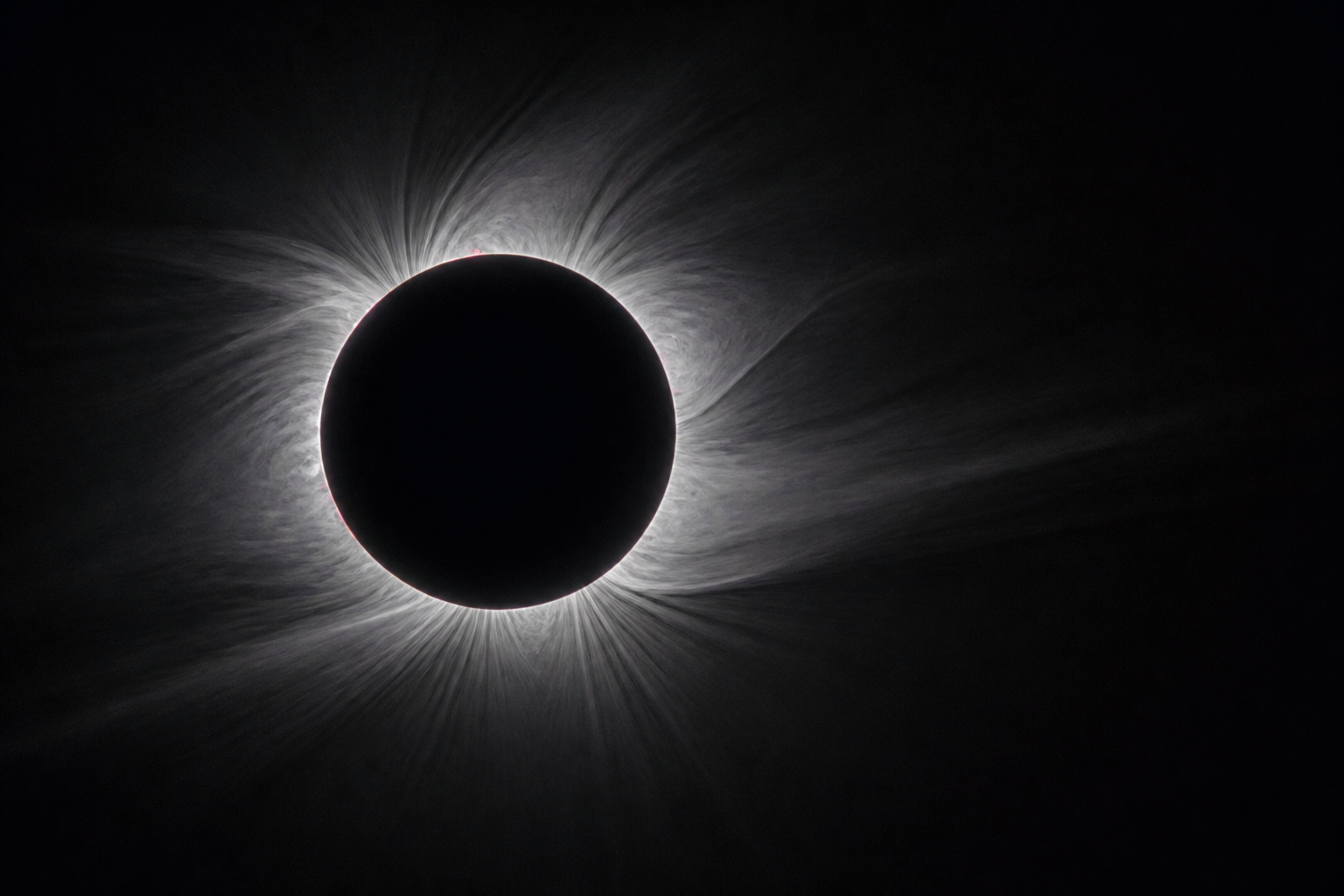
The public spectacle and the scientific opportunity are inseparable. NASA's recently detailed 2026 eclipse campaign will place a multispectral camera system aboard a WB-57 high-altitude aircraft and atmospheric experiments beneath scientific balloons in Iceland and Spain. Together they will examine two linked responses to the sudden loss of direct sunlight: the fine structure of the solar atmosphere above the photosphere and the rapid adjustment of Earth's lower atmosphere below it.
Nearly three minutes with the corona
The aircraft experiment uses the SCIFLI Multispectral Airborne Imager, or SAMI, mounted in the nose of a NASA WB-57. Four cameras will acquire high-resolution images in visible and infrared bands at a rate of at least 20 frames per second. Flying near 50,000 feet puts the instrument above ordinary weather and much of the water vapor that absorbs useful infrared wavelengths. The aircraft will also chase the shadow at about 460 miles per hour. While the longest ground-based totality is approximately two minutes and 18 seconds, the moving platform should keep the corona visible for nearly three minutes.
That additional time is scientifically substantial. Coronal structures extend over a huge range of brightness, from the intensely luminous inner corona near the solar limb to faint streamers several solar radii away. Rapid sequences with carefully chosen exposure times let researchers separate persistent magnetic structure from evolving knots, outflows, and prominence material. The team adjusted its exposure strategy after parts of the 2024 eclipse data saturated, an ordinary but important example of one eclipse informing the next.
The underlying questions are fundamental heliophysics. The visible solar surface is near 5,800 kelvin, yet the overlying corona reaches temperatures of order one million kelvin. Magnetic energy, waves, reconnection, and small-scale dynamics all contribute, but the partition of energy is still an active research problem. The same magnetized plasma eventually feeds the solar wind. A well-calibrated sequence through the inner and middle corona helps connect structures near the limb with material flowing outward through the heliosphere, where it can affect spacecraft, communications, and Earth's space environment.
An atmospheric switch-off experiment
The shadow also provides an unusually sharp forcing function for atmospheric science. Daylight normally changes gradually, entangled with the regular evolution of temperature, moisture, turbulence, and surface heating. A total eclipse removes a large fraction of incoming solar radiation in minutes and restores it just as quickly. The atmosphere cannot reach a new equilibrium in that time; its lag and vertical response reveal how its layers exchange heat and momentum.
In Iceland, two teams in the NASA-supported Nationwide Eclipse Ballooning Project plan to release 80 balloons from 18 hours before totality until eight hours afterward. Their target is the atmospheric boundary layer, the turbulent lowest part of the atmosphere that remains coupled to the surface. Balloon campaigns during the October 2023 and April 2024 eclipses found that the boundary layer decreased markedly in clear conditions but not beneath cloud. Iceland offers a different test: long August daylight, short nights, maritime air, and a relatively late eclipse may produce a response unlike that seen at lower latitudes.
Three teams in Spain will launch six additional balloons carrying 360-degree cameras and ozone sensors. Their images should record the geometry of the approaching and receding shadow from altitude. The chemical measurements address a faster and subtler question. Atmospheric ozone production depends on sunlight-driven reactions, and the 2024 balloon campaign measured a decrease during totality. The 2026 event occurs in another season and at a later local time, allowing researchers to test how reproducible that response is under different background photochemistry and meteorology.
What ground observers should notice
Even without instruments, a careful observer can recognize the same coupled system. Illumination becomes silvery as the remaining photospheric crescent narrows; shadows sharpen; surface temperature often falls; wind and shallow cloud may respond; the horizon retains warm color outside the umbra while the local sky darkens. During totality the corona is not a uniform halo. Helmet streamers, polar plumes, prominences, and fine radial structure trace the Sun's magnetic geometry on that particular day. No prediction or illustration can replace that morphology because the Sun is continuously changing.
For anyone on the ground, safety remains absolute. Certified eclipse glasses or a safe handheld solar viewer are required throughout every partial phase. Cameras, binoculars, and telescopes need a securely mounted solar filter over the front aperture; eclipse glasses placed behind magnifying optics are dangerous. Only observers who have confirmed that they are inside the path of totality may remove protection after the bright photosphere has disappeared completely, and the filter must be replaced before totality ends. A partial eclipse is never safe to view directly without protection.
The NASA path information shows totality across Greenland, Iceland, Spain, and the other narrow path segments, with a partial eclipse visible across a much broader portion of the Northern Hemisphere. In Spain the Sun will be low in the west, so a clear horizon is as important as being inside the path. StargazingPal can help compare the precise Sun position, hourly cloud forecast, satellite view, saved locations, and local observing conditions as the final decision is made. Weather mobility matters, but no forecast justifies unsafe driving or entering restricted ground.
NASA's public broadcast begins at 1:15 p.m. EDT on August 12, carrying views from Iceland and Spain. The live images will be beautiful, but the measurements behind them are the deeper story. For a few minutes, one moving shadow will let instruments sample the million-degree solar corona, the terrestrial boundary layer, and sunlight-dependent atmospheric chemistry almost simultaneously. Few astronomical events connect the Sun and Earth so directly, or make the logic of an experiment so plainly visible.